

Why did a lender call your business “pre-qualified” before seeing any bank statements? This phrase usually means a quick check, not a sure decision about your ability to pay back the loan.
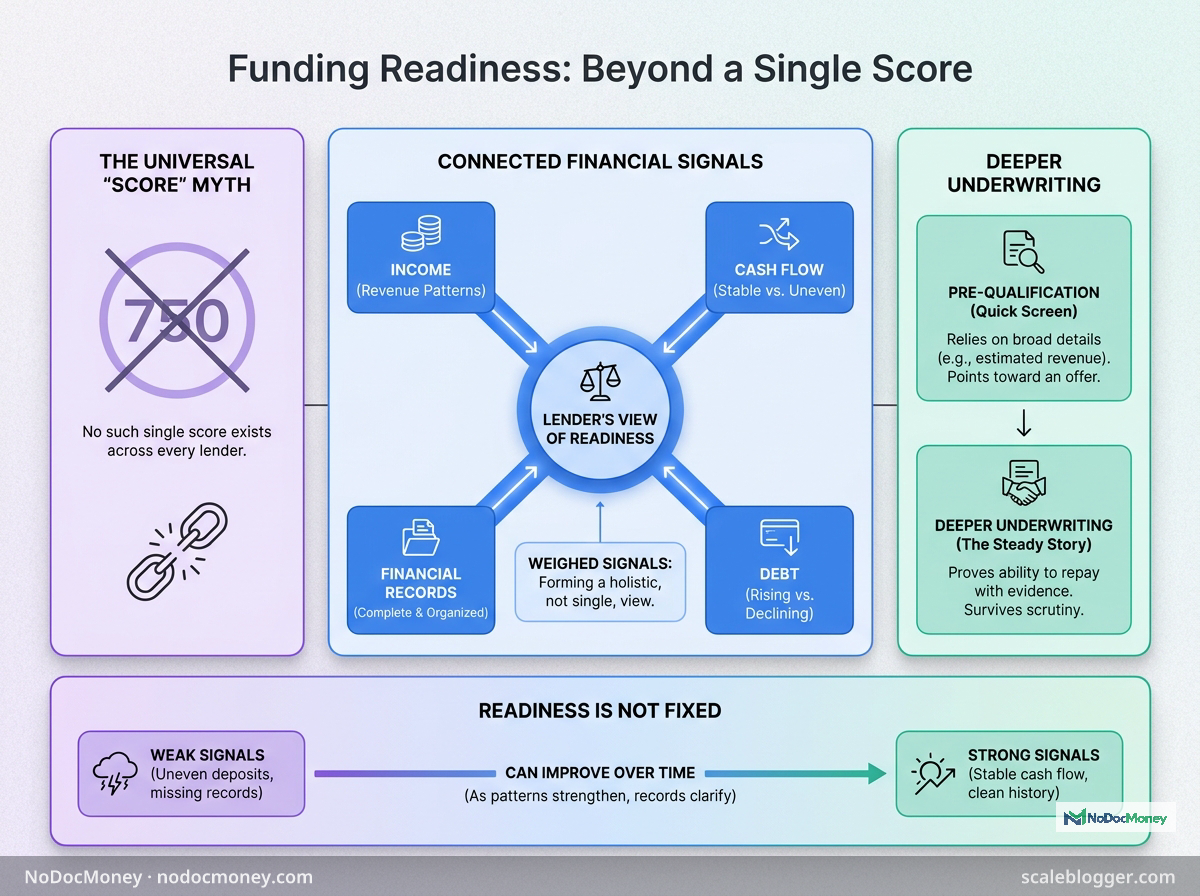
When owners look for a funding readiness score, they often expect one simple number. But lenders decide how well your business can repay by weighing many connected signs. These include income, cash flow, debt, and financial records.
Knowing how lenders evaluate small business loan applications changes the question from “Will I qualify?” to “What does my business show now?” Readiness can get better as revenue grows steadier, records get fuller, and money problems ease.
Table of Contents
- What Is Funding Readiness?
- Why Funding Readiness Matters Before You Apply
- How Lenders Evaluate the Four Dimensions of Readiness
- Funding Readiness in Practice: Examples and Misconceptions
- How to Improve Your Funding Readiness Before Applying
- Turn a Pre-Qualification Into Real Confidence
Quick Answer: Funding readiness reflects a business’s overall strength across financial health, credit history, documentation, and the fit between loan purpose and repayment ability, rather than a single score. Lenders assess these interconnected factors—such as cash flow trends and debt capacity—to judge if a business can responsibly handle new financing. Improving readiness involves strengthening revenue patterns, organizing financial records, and aligning loan requests with business needs before applying.
What Is Funding Readiness?
Could your business look good on paper but still seem risky to a lender? Funding readiness means how strong your business is before you apply for a loan. It is not just one score and does not guarantee approval.
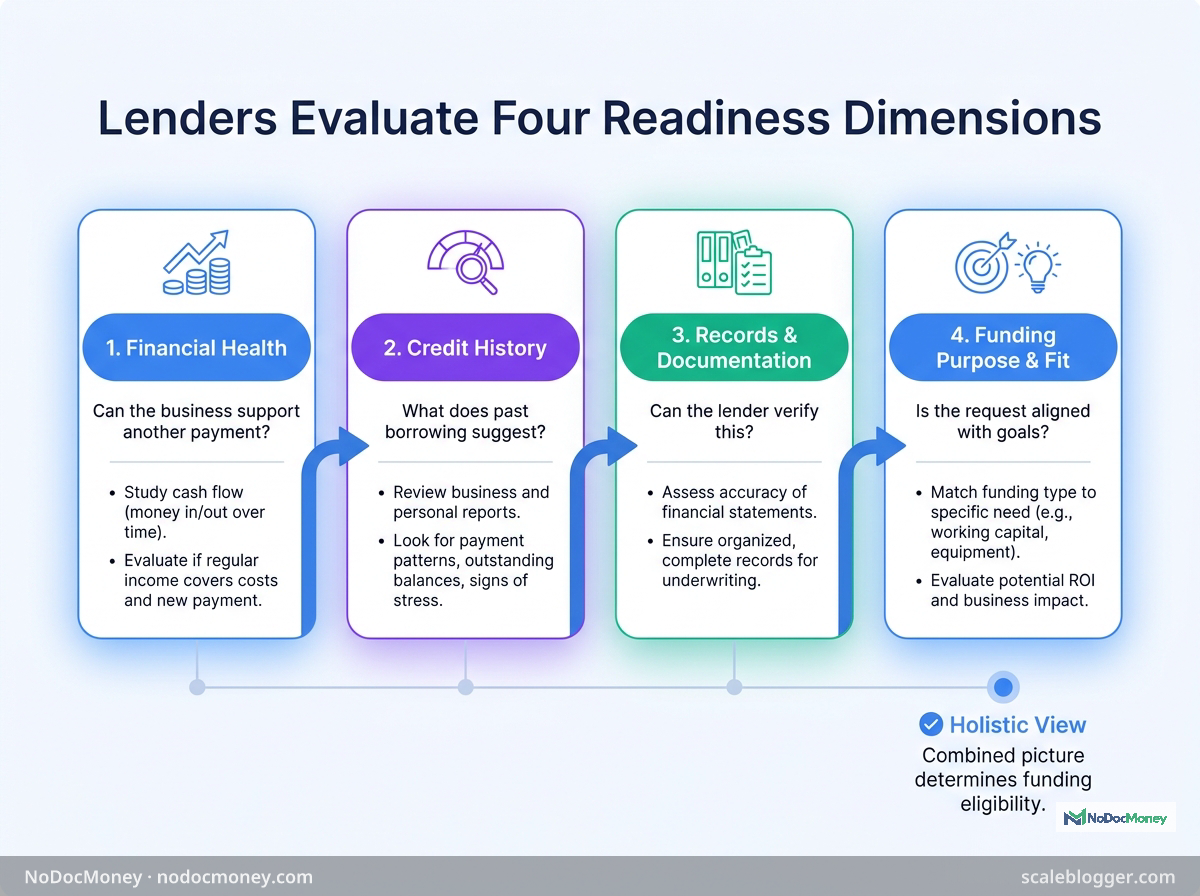
It covers four linked parts: financial health, credit history, records and documents, and funding purpose with repayment fit.
Together, these help a lender decide if your business can handle new debt and if the loan request makes sense.
Financial health covers revenue trends, profits, cash on hand, and cash flow—the money coming in and going out over time. Credit history shows how the business and owners handled loans. Records and documentation give proof, like bank statements, tax returns, licenses, and accounting reports. What’s needed can differ.
Funding purpose and repayment fit link the loan to a real business need.
A lender may treat equipment loans that boost production differently than debt used to cover ongoing losses. Debt capacity means how much new borrowing the business can pay back without trouble.
No single funding readiness score is used by all lenders.
A funding readiness assessment can group these factors to teach owners and help find weak spots before applying.
It can’t predict what a lender will decide because each one has its own underwriting method. This means reviewing risk, repayment, business history, and loan terms.
Think about two example businesses, each with $200,000 in yearly revenue.
One has steady deposits, good bookkeeping, strong credit, and a clear plan to pay back an equipment loan.
The other has uneven cash flow, missed payments recently, incomplete records, and no clear plan for the loan money.
Both make the same revenue, but the lender might trust one much more than the other.
This difference also shows what pre-qualification means.
Pre-qualification is an early sign you might meet some basic checks. It often uses limited information or a first credit check.
It is not a final approval, formal offer, or promise about loan rates.
The full underwriting process might find different revenue patterns, unpaid debts, missing documents, problems with collateral, or risks due to the business’s age or field.
Lenders have different standards depending on the loan type and the borrower.
So, funding readiness is best seen as a picture you can improve, not a pass-or-fail grade.
Improving records, knowing your cash flow, and linking the loan request to a real repayment plan can make your next application stronger.
Why Funding Readiness Matters Before You Apply
Knowing what a lender looks for early can stop you from feeling frustrated or wasting time.
Readiness affects not only if you qualify but also how much you can borrow, the cost, and if the loan fits your needs.
Lenders check signs like steady cash flow, good credit, complete records, and if the loan purpose matches your ability to repay.
| Readiness dimension | Stronger signal | Potential concern | Why a lender may care |
|---|---|---|---|
| Cash flow and financial health | Consistent revenue covering costs and payments | Fluctuating deposits or insufficient reserves | Indicates capacity to make loan payments reliably |
| Business and personal credit | Stable payment history, manageable existing debt | Missed payments, limited credit data | Reflects past borrowing behavior and risk |
| Records and documentation | Clear, matching financial and ownership documents | Incomplete, inconsistent, or outdated records | Supports verification of business facts and financial health |
| Funding purpose and repayment fit | Specific, justified use aligned with cash flow | Vague or risky purpose without clear repayment plan | Ensures loan aligns with realistic business needs |
Checking your readiness first helps you gather clear records, confirm your loan purpose, and see how much borrowing you can handle.
Readiness won’t guarantee approval but will make your application easier and talks with lenders clearer.
How Lenders Evaluate the Four Dimensions of Readiness
Lenders don’t decide based on just one number. Funding readiness is the full view of your money health, credit, records, and loan purpose.
Underwriting, which means checking how likely you are to repay, looks at all these parts together, not separately.
Financial health: can the business support another payment?
Lenders look at cash flow—money coming in and going out over time.
They check if regular income can pay for costs, debts, and a new loan without harming the business.
Just having sales revenue isn’t enough.
Two businesses might both have $180,000 in yearly sales.
But one has steady deposits, manages expenses well, and has little debt.
The other has uneven income, small profits, and big bills coming up.
Lenders will react very differently to each.
Credit history: what does past borrowing suggest?
Business and personal credit history may both matter, especially for newer companies with limited commercial borrowing records.
Credit reports show if payments were on time, how much is owed, recent loan requests, and any money troubles.
Good credit doesn’t mean automatic approval, and bad credit isn’t the whole story.
It helps lenders see how the owner and business managed past loans.
Records and documentation: can the lender verify the story?
Lenders may ask for bank statements, tax returns, sales records, debts, ownership info, and basic business facts.
These documents need to agree.
If revenue, deposits, and tax papers differ a lot, lenders will ask questions before deciding.
Funding purpose and repayment fit: does the request make sense?
Lenders want to know what the loan will buy, how much is needed, and if the business cash flow can pay it back.
Buying equipment to grow production is different from borrowing to cover losses.
Neither is always good or bad, but the reason must fit the business situation and loan type.
Lenders combine these dimensions according to their own policies.
An educational assessment can highlight weak areas, while a lender-specific model may weigh industry, collateral, business age, loan size, and product type differently.
Banks, online lenders, and local programs ask alike questions but judge risk differently.
Readiness can rise if records get better, debt shrinks, revenue steadies, or the loan request is clearer.
The key is if the proof supports the loan the business wants.
Funding Readiness in Practice: Examples and Misconceptions
What does funding readiness look like when real businesses do not fit a simple pass-or-fail score? A business funding readiness assessment is educational, not a lender’s decision.
The same revenue can tell different stories
Think of a catering company making $180,000 a year.
Its sales look good, but customer payments come months before big events.
Payroll and supplier bills happen at different times.
This uneven cash flow means it’s harder to guess when it can repay a loan.
Now think about a young landscaping business making the same amount.
It has only worked for 18 months but keeps neat records, separates personal and business expenses, files taxes, and keeps contract papers.
The short history worries lenders, but clear records give them better proof to check.
A third owner might have steady sales and a strong business bank account.
But this owner has bad personal credit.
For many small or new businesses, lenders look at personal credit because the business lacks its own history.
Sales help, but don’t fix all risk concerns.
Purpose changes the financing question
A business seeking equipment financing is asking a different question from one seeking working capital.
The equipment may support production or generate income, while the asset itself may affect the lender’s risk and collateral analysis.
Imagine a repair shop asking for a loan to buy a diagnostic machine, with a clear price and plan.
This loan is easier to judge than asking for general cash.
But lenders still want proof the shop can repay this new debt safely.
Lenders look at small business loans by checking if the request, proof, and repayment plan all make sense—not just revenue.
Misconceptions that create confusion
Revenue alone proves readiness: Revenue shows sales only. It doesn’t show profit quality, when payments arrive, existing debts, or record truthfulness.
No-document financing requires no preparation: Some loans with less paperwork still need lenders to check risk.
Bank records, credit, sales patterns, and loan purpose still matter.
Funding readiness is not fixed.
It gets better when money health, credit, records, and purpose tell a clearer, unified story about repayment.
How to Improve Your Funding Readiness Before Applying
Make your funding readiness better by clearly stating your goal, how much money you need, and when you will repay it.
Then gather good proof to support your request.
A realistic loan links the money to a real business need and shows how repayment fits expected cash flow. Cash flow means money coming in and going out. Debt capacity means how much extra debt the business can handle without problems.
A practical readiness assessment
The table below is preparation guidance, not a universal underwriting checklist.
Lenders vary by product, business age, industry, and risk standards.
| Readiness area | Questions to ask | Evidence to gather | Possible improvement |
|---|---|---|---|
| Cash flow | What enters and leaves the business each month? Are seasonal dips visible? | Recent business bank statements, sales records, and a monthly cash-flow forecast | Separate business and personal spending, update projections, and explain unusual fluctuations |
| Credit | What do the business and owners’ credit profiles show? Are there errors or unpaid accounts? | Credit reports, payment history, current balances, and existing debt terms | Dispute inaccurate information, reduce avoidable balances, and make payments on time |
| Documentation | Do business, tax, banking, and ownership records tell the same story? | Formation documents, tax filings, bank records, ownership details, licenses, and financial statements | Use consistent business information and organize records by year and account |
| Use of funds and repayment plan | How much is needed, what will it purchase, and when will repayment begin? | Vendor quotes, invoices, project budgets, and a repayment estimate based on projected cash flow | Narrow the request, document the purpose, and test repayment against slower revenue months |
Think about two businesses with $120,000 yearly sales.
One has neat records, small debt, and a clear equipment purchase.
The other has messy accounts and random money withdrawals.
Even with the same sales, lenders see their risk very differently.
Check credit reports early.
Fix problems you can, like wrong info or messy records.
Know that some needs depend on the loan type.
Choose equipment loans for buying equipment, and working-capital loans for things like uneven expenses.
Try pre-qualification after collecting key facts.
Ask what data it uses, if it checks credit, and which details are still open.
Getting ready can make talks with lenders easier but won’t promise approval, interest rates, or exact loan terms.
What is a reasonable credit score to get a small business loan?
A reasonable credit score for a small business loan typically depends on the lender and loan type, but generally a score above 650 is considered favorable. Lenders assess credit history alongside financial health, cash flow, and documentation to evaluate overall funding readiness rather than relying solely on credit scores.
How hard is it to get a $1,000,000 business loan?
Obtaining a $1,000,000 business loan is challenging and requires strong funding readiness, including consistent cash flow that can cover loan payments, a solid credit history, complete documentation, and a clear loan purpose aligned with repayment ability. Lenders thoroughly evaluate these factors to determine if the business can support large debt without undue risk.
Can I get an SBA loan with a 600 credit score?
Securing an SBA loan with a 600 credit score is difficult because SBA lenders generally favor stronger credit histories as part of the overall funding readiness. However, approval can still be possible if the business demonstrates strong financial health, stable cash flow, comprehensive records, and a convincing repayment plan.
What is the payment on a $1,000,000 business loan?
The payment on a $1,000,000 business loan varies based on the loan term, interest rate, and repayment schedule, but lenders expect the business’s cash flow to comfortably cover these payments alongside existing obligations. The exact monthly amount must align with the business’s ability to repay without financial strain.
What are the new SBA loan requirements for 2026?
As of now, specific new SBA loan requirements for 2026 are not detailed; however, SBA loans continue to emphasize strong funding readiness, including reliable cash flow, solid credit history, complete documentation, and a clear loan purpose matching repayment capability. Prospective borrowers should stay informed through official SBA communications for updates.
Turn a Pre-Qualification Into Real Confidence
A quick check might spot potential, but a full review looks at cash flow, credit, business age, and documents all together.
Being strong in one area can’t always make up for weak spots.
A business with good sales but irregular cash flow may seem good at first but still worry lenders.
Better records and steady deposits can improve how lenders see it over time.
Today, check your business funding readiness by looking at deposits, expenses, debt payments, and account balances from the last three months.
Write down one problem, like missing papers or unstable cash flow.
Pick one clear fix and follow it for 30 days.
This proof will help you learn how lenders review small business loans and make your next talk clearer.
Sources
- Small Business Loan Requirements for 2027: What Lenders Look at Before Approving Funding If you're planning to apply for a small business loan or business fundi (Accessed: November 12, 2026)
- A business loan rejection doesn't always mean your business is a bad risk. Here's what I'd look at before applying again. One thing worth understanding about bu (Accessed: November 12, 2026)
- Declined with a good score — what are they actually looking at? Score's fine, income's fine, and I still got refused for a small amount. What's going on behind (Accessed: November 12, 2026)
- Business Funding I work on the funding side of the industry, and one of the most common surprises I see is how differently funders review applications. People u (Accessed: November 16, 2026)
- Ever wondered why your loan/CC got rejected despite an 800+ CIBIL? Meet Experian Hunter—the silent blacklist backend banks never tell you about. If you hang aro (Accessed: November 12, 2026)
- Can you all check my numbers? FTHB and nervous. Family of 5 currently renting a 2/1 in an extremely tight market in Alaska. We need to upgrade space, ready to p (Accessed: November 12, 2026)
- SBA Loan Readiness Score: How to Know If Your File Is ... (Accessed: November 16, 2026)
- Funding Readiness Score — How Fundable Is Your Business? (Accessed: November 16, 2026)
- Boost Funding Chances with Your Business ... (Accessed: November 16, 2026)
- How to Get Funding Ready: A Business Loan Readiness Guide (Accessed: November 16, 2026)
- Grant Funding Readiness Self-Assessment - SCORE.org (Accessed: November 16, 2026)
- Doryn Dippenaar's Post (Accessed: November 12, 2026)
- Business Loan Readiness Score (Accessed: November 16, 2026)
- iTHINK Financial (Accessed: November 12, 2026)
- Bank of America (Accessed: November 12, 2026)