

A signed letter of intent often marks the beginning of the most urgent phase.
But actually, it's just the start of the most urgent phase: proving the business works, getting financing, and making sure you can back out if needed.
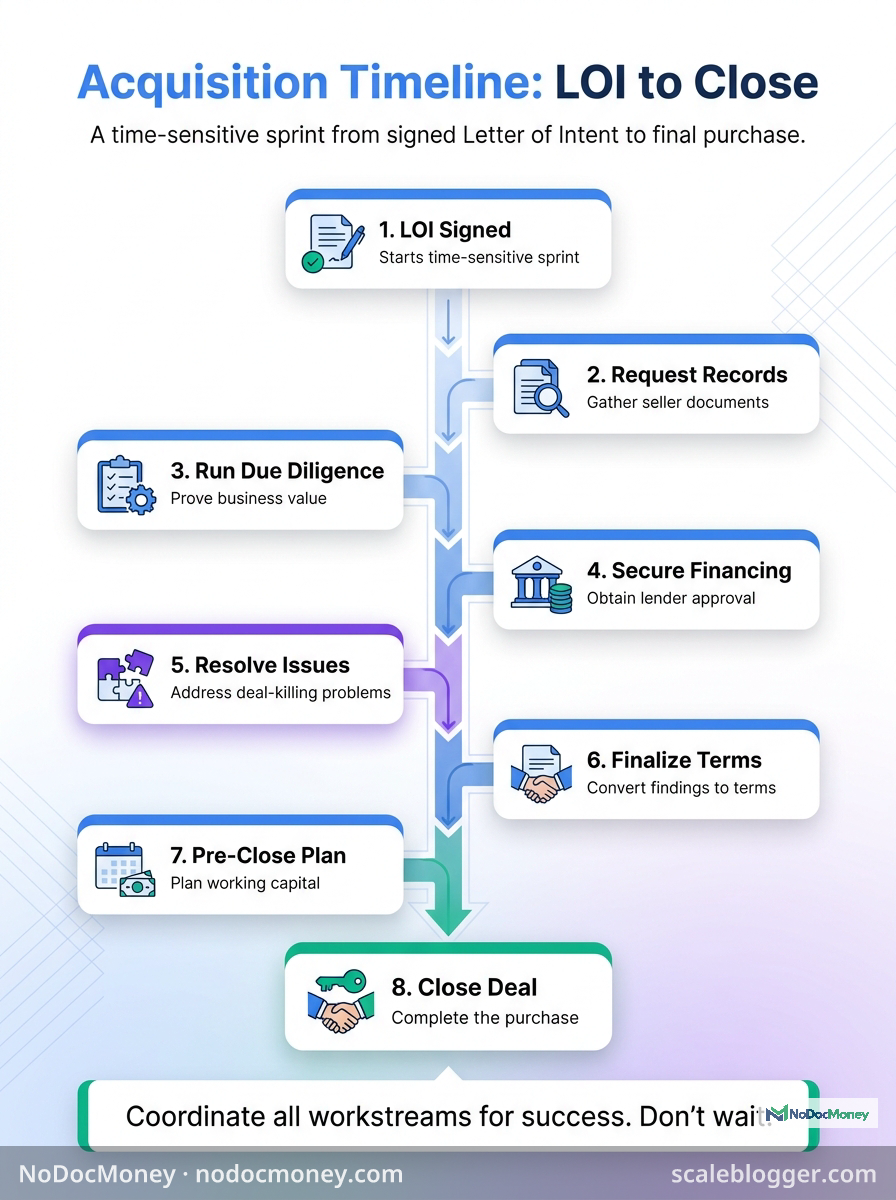
After signing the LOI, many tasks happen at the same time.
The lender wants financial records and explanations.
Your advisors need contracts, tax papers, leases, and ownership facts.
The seller expects clear requests, fast decisions, and steady progress toward closing on time.
This creates a timing challenge.
If you wait for due diligence to finish before talking to lenders, there may be too little time for loan approval.
If you apply for financing before fully understanding the business, you may get bad loan terms, missing documents, or have your financing option expire.
A good acquisition financing timeline treats the LOI period as a coordinated sprint.
The purchase plan, financing, due diligence, contract, and needed approvals must all move forward together.
A delay in one part can quickly affect others.
A helpful business acquisition due diligence checklist does more than just gather documents.
It links each request to decisions: does the earnings match the price? Do assets and contracts transfer cleanly? Are working capital assumptions fair? Can the lender approve the deal?
Timing for deals varies a lot.
Research from 2024 says due diligence and exclusivity periods often last 30 to 90 days. Some experts say financing and due diligence happen together for about 90 days.
Your LOI should make this uncertain timing clear by setting deadlines, owners, and conditions for closing.
Table of Contents
- Week 0: Sign an LOI That Protects Your Financing and Due Diligence
- Week 0: Sign an LOI That Preserves Financing and Due Diligence Leverage
- Weeks 1–2: Ask for Seller Records Before the Lender Requests Them
- Weeks 1–2: Request Seller Records Before the Lender Asks
- Weeks 2–4: Do Financial Due Diligence and Send the Financing Package
- Weeks 2–4: Run Financial Due Diligence and Submit the Financing Package
- Weeks 4–6: Fix the Issues That Often Kill Deals
- Weeks 4–6: Resolve the Issues That Commonly Kill Deals
- Weeks 5–7: Turn Due Diligence Results Into Final Deal Terms
- Weeks 5–7: Convert Due Diligence Findings Into Definitive Deal Terms
- The Pre-Close Working Capital Plan That Many Timelines Overlook
- The Pre-Close Working Capital Plan Most Timelines Skip
- Troubleshooting: What to Do When the Timeline Falls Behind
- Troubleshooting: What to Do When the Timeline Slips
- Final Check Before You Close
- Final Verification Before You Close
- Turn the Timeline Into a Closing-Management System
Quick Answer: Typically, the timeline from letter of intent (LOI) to closing spans 30 to 90 days, during which due diligence and financing processes proceed concurrently to ensure efficiency. The LOI establishes critical deal terms and contingencies, including financing approval and due diligence deadlines, to coordinate document review, lender underwriting, and closing preparations. Properly managing these parallel workstreams minimizes delays and protects the buyer’s leverage throughout the transaction.
Week 0: Sign an LOI That Protects Your Financing and Due Diligence
Use the LOI as a tool to control the deal, not just a formal paper.
Before you sign, agree on the price, how to get financing, how long due diligence lasts, deposit rules, and access to information.
- Define the deal scope. Decide if you buy assets or stock. List which assets are included and which debts remain with the seller. Include inventory, deposits, IP, contracts, equipment, cash, debt, and any exclusions. Also, set the working capital target and how to calculate it.
Check: Your lawyer can make a sample closing statement without guessing what is included.
- Add financing and due diligence conditions. Make closing depend on lender approval and a good review of financial, tax, legal, lease, lien, and compliance records. Do financing and due diligence at the same time. Lenders may reject add-backs without proof, revenue that does not match, or collateral with liens.
Check: The LOI says who decides if conditions are met, when they end, and if extensions are allowed.
- Protect your deposit. Say where the deposit will be held, when you can get it back, and when it counts toward the price. Get a full refund if financing fails, major problems appear, or the seller can’t provide records. Get written agreement for any deadline extensions.
Check: You know exactly when your deposit will be returned.
- Make access clear. Require timely access to documents, employees, customers (if needed), premises, systems, and interviews with management. Use a due diligence checklist to track requests and missing info.
Check: The seller agrees to the list of requests and names someone to answer.
Assign each condition a responsible person, deadline, and clear exit plan before exclusivity or spending on due diligence begins.
Weeks 1–2: Ask for Seller Records Before the Lender Requests Them
Organize your first document request
Send one clear, organized request to the seller’s broker. Group the documents into financial, legal, operational, and lender sections. This cuts down confusion and speeds up replies.
- Check financial records. Compare tax returns, internal reports, bank statements, and tax transcripts. Explain any differences in revenue, owner pay, debt payments, inventory, or cash flow. Some lenders care more about tax returns than the seller’s statements.
- Review adjusted cash flow claims. Check add-backs like personal, one-time, or repair costs. Ask for invoices and proof of payment. Not all expenses can be ignored just because they appear in adjusted earnings.
- Check asset titles and debts. Look for liens, UCC filings, payoff letters, leases, equipment ownership, and collateral not tied to mortgages. Make sure you understand how assets will transfer.
- Confirm operational facts. Match big customers and vendors with contracts. Check employees against payroll and benefits. Confirm licenses match ownership. Review insurance, claims, permits, disputes, taxes, and consents.
Keep a shared log with each request’s name, seller contact, request and receipt dates, reviewer, and status (like confirmed, needs explanation, or blocking issue).
By the end of week two, each key document should have an assigned responsible person, target date, and a clear plan to prevent surprises during lender review.
Weeks 2–4: Do Financial Due Diligence and Send the Financing Package
Use the documents you receive to create a clear financial model ready for the lender.
- Normalize cash flow. Review tax returns, income statements, bank deposits, payroll, debt payments, and balance sheets. Build a monthly model that separates regular operating profit, unusual expenses, owner pay, and working capital changes. Show steady cash flow.
- Check add-backs. Provide proof for personal, discretionary, and one-time expenses. Do not include unsupported changes or ongoing costs like replacement wages or needed expenses.
- Calculate debt capacity. Use proposed loans, repayment terms, and underwriting rules. Compare cash flow to loan payments. Test the model with lower sales, slower payments, and higher working capital needs.
- Prepare buyer’s financing package. Gather personal financial statements, resumes, tax returns, proof of cash, credit authorizations, ownership plans, and role descriptions. Confirm lender needs early because these vary by lender, deal, and location.
| Financing type | When used | Key inputs | Timing issue | Working capital notes |
|---|---|---|---|---|
| Conventional loan | Stable, established business | History, collateral, credit, repayment ability | Bank approval and valuation time | Keep buyer cash reserves |
| SBA loan | Small business buying | Eligibility, cash flow, management, collateral, guarantees | Lender and SBA review time | Budget post-closing cash |
| Seller financing | Value gaps, funding shortfalls | Buyer confidence, note terms, subordination, repayment | Negotiation and lender approval time | Lowers upfront cash need |
| Equipment financing | Equipment purchase | Value, life, cash flow, liens | Appraisal and review time | Separates equipment from business cost |
| Line of credit | Seasonal cash needs, receivables | Borrowing base, reporting | Ongoing reports | Not for purchase price |
| Buyer equity/capital | Capital structure support | Source, liquidity, terms, priority | Verification and subordination | Keep initial cash reserves |
Weeks 4–6: Fix the Issues That Often Kill Deals
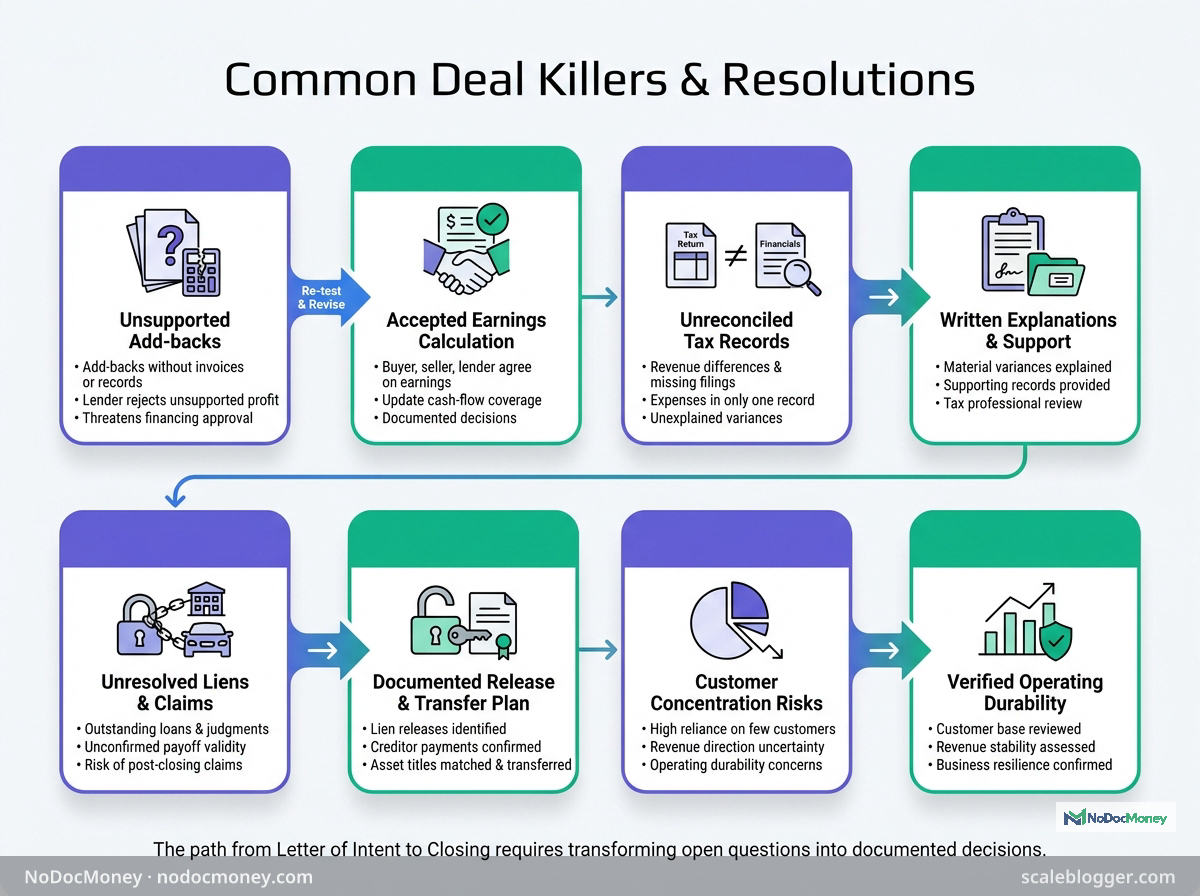
At week four, any open problems might stop financing or the deal.
Use this time to turn questions into clear decisions.
- Confirm earnings changes. Remove add-backs that lacked support before. If lenders reject some, update cash flow and adjust financing requests.
Check: Buyer, seller, and lender agree on the final earnings.
- Fix tax and financial gaps. Look into unexplained revenue changes, missing or amended filings, and unique expenses found before.
Check: Each big difference has proof and explanation.
- Clear liens and check ownership. Make sure payoff letters and lien releases stay valid until closing. Confirm major assets have proper titles or leases and clear transfer rules.
Check: The closing plan lists all lien releases, payments, leased assets, and asset transfers.
- Review operational risks. Check risks like customer concentration, falling sales, key employee dependence, or owner roles. Make transition plans if needed.
Check: Buyer and lender agree on how to handle each big risk.
Use a red-yellow-green status to track issues:
- Green: OK to go ahead.
- Yellow: Needs fixing, repricing, or safeguards.
- Red: Deal-breaker; think about pausing or quitting.
By week six, fix or exit any major problems before spending more money.
Weeks 5–7: Turn Due Diligence Results Into Final Deal Terms
At this point, confirmed due diligence results become firm prices, detailed contracts, and clear closing rules.
Week 5: Update deal numbers
Start by changing the purchase price and working capital goals. Remove unsupported add-backs, add new debts, and adjust for excluded assets or contracts.
Tell the lender quickly about big price changes. These might affect loan approval, equity, or seller financing.
Create a clear, documented explanation from the LOI numbers to the final contract terms.
Week 6: Add legal protections
Work with your lawyer to cover major risks found during due diligence by:
- Representations and warranties about ownership, taxes, contracts, employment, rules, and finances.
- Indemnities that assign responsibility for claims after closing from earlier issues.
- Escrow and survival terms that set holdbacks, claim rules, deadlines, and warranty periods.
Make sure all title transfers, lien releases, lease assignments, licenses, permits, and insurance meet lender requirements.
Week 7: Finalize closing conditions
Make a full list of closing conditions. Assign a responsible person, deadline, and proof needed for each.
Include lender approvals, signed releases, needed consents, insurance certificates, and transfer papers.
Also plan backup options for financing delays or shortfalls like extending deadlines, extra equity, seller financing, renegotiations, or ending the deal.
Finishing this means your purchase agreement fully reflects all confirmed due diligence, replacing original LOI estimates.
The Pre-Close Working Capital Plan That Many Timelines Overlook
Getting financing approved is not the last step before closing. Make sure you have enough cash to run the business apart from the purchase price.
- Create detailed cash flow forecasts. Estimate payroll, inventory, rent, taxes, debt payments, repairs, and key subscriptions for the first 30, 60, and 90 days after closing. Use current invoices, payroll records, tax bills, maintenance plans, and seasonal trends instead of rough guesses.
- Protect your personal cash. Set aside money for home expenses and unexpected personal costs. Don’t spend all your cash on the down payment, closing costs, or price gaps.
- Find funding sources. Decide if working capital will come from your own equity, seller financing, credit lines, or business cash. Check your purchase agreement and lender rules allow your plan. These rules vary by lender, place, and deal type.
- Set a cash minimum and monitoring plan. Decide the least cash you need after closing for key expenses. Plan regular checks of cash, accounts receivable, bills due, inventory needs, and borrowing ability.
Use a live control document to track cash needs, funding, and responsible people. Link this closely to your due diligence process.
Check: You should be able to run normal operations, keep personal cash reserves, and handle likely surprises without needing quick refinancing.
If not, change your financing mix or deal terms before closing.
Troubleshooting: What to Do When the Timeline Falls Behind
When delays happen, follow clear steps instead of just hoping things speed up.
- Track every problem. Write down missing documents, lender questions, financial changes, or legal issues in a dated, central tracker. Assign owners, check the impact, plan responses, and set deadlines.
- Push for missing info. Request full replies and clear contacts from the seller’s broker. If lenders want documents you didn't send first, provide them quickly. Ask if underwriting can continue while waiting.
- Update financial forecasts. If revenue or cash flow drops during underwriting, update your lender package with current numbers. Check loan capacity and cash instead of defending old estimates.
- Sort late problems. With legal and expert help, decide if liens, tax issues, lease problems, or equipment ownership gaps can be fixed, reduced, or stop the deal. Get fixes, releases, consents, or closing conditions in writing.
- Change deal economics. If appraisals, values, or lender approvals fall short, consider new prices, more equity, seller financing, or a smaller deal. Don’t try to cover money gaps with working capital.
- Handle deposit deadlines. Before financing ends, get written extensions, change escrow instructions, or use contract termination rights. Check if deposits are refundable while conditions are unmet.
Make sure each step is planned, recorded, and has a clear exit or fix for your deal, lender, and legal situation.
Final Check Before You Close
Do this full review just before signing the closing papers, after lender conditions are met and documents are ready.
- Make sure the business you get matches the deal. Compare the closing statement, asset lists, inventory counts, customer deposits, accounts receivable, contracts, employees, and debts with the purchase agreement. Check and record any differences that affect value, cash flow, or operations.
- Confirm clear ownership and releases. Make sure the seller can transfer assets and ownership. Get lien searches or releases and confirm third-party permissions from landlords, franchisors, or lenders.
- Secure operating protections. Check insurance policies are active, licenses and permits are valid, and key contracts transfer properly. Confirm post-closing tasks like seller help, training, introductions, and record deliveries have responsible people and timelines.
- Match money to plans. Reconcile your equity, loans, seller financing, fees, working capital, and holdbacks with wiring instructions and closing papers. Verify fund transfers through trusted contacts, not just lender emails.
- Plan first-week operations. Create a schedule for payroll, customer notices, banking, vendor payments, insurance follow-ups, bookkeeping, and financing checks. Set goals for cash, loan payments, and working capital.
This last step helps you keep control after signing, protecting your investment and business.
Having a done due diligence checklist at closing protects you as you take ownership.
How long between due diligence and closing?
The period between due diligence and closing typically spans 30 to 90 days, with due diligence and financing processes running concurrently. This overlap ensures sufficient time for lender underwriting, document review, and closing preparations, minimizing delays and preserving buyer leverage.
How long does acquisition due diligence take?
Acquisition due diligence generally takes about 4 to 7 weeks, starting immediately after signing the letter of intent. During this time, financial reconciliation, contract reviews, and operational assessments are completed alongside preparing documentation for financing approval.
Can a seller walk away during due diligence?
Yes, a seller can walk away during due diligence if the letter of intent or purchase agreement allows it, especially if conditions such as financing contingencies are not met. Both parties use the due diligence period to confirm terms and maintain the right to proceed or terminate based on findings.
What happens after the due diligence period ends?
After due diligence concludes, buyers and sellers convert verified findings into definitive deal terms, including revising purchase price and contracts. This phase finalizes the pricing, addresses any unresolved issues, and sets the stage for lender financing approval and closing preparations.
Turn the Timeline Into a Closing-Management System
Going from a letter of intent to closing works best as a focused financing sprint, not a loose checklist.
Before starting, define the deal, financing goal, decision dates, and when to stop or renegotiate. Then gather your team, set up regular communication, and build the deal room before the seller or lender asks.
By weeks 7–8, success means answering lender conditions without causing other problems.
Update financial statements, bank records, tax papers, and proof of cash. Then coordinate the lender, buyer, seller, lawyers, escrow agent, and broker using one closing checklist.
The acquisition financing timeline only works if everyone uses the same up-to-date facts.
A key habit is not treating approval as the end.
Before funds move, review the settlement statement, sources and uses, payoff letters, and funds instructions together. No money should transfer until the final documents and sources-and-uses schedule match.
Begin by creating the deal room and documenting your financing goal, decision dates, closing team, and stop-or-renegotiate rule. Use this as your control panel for the remaining weeks.
Sources
- Letter of intent to buy a business: what goes in an LOI, what's binding, and what buyers and sellers should watch for A letter of intent (LOI) to buy a business (Accessed: November 21, 2026)
- Letter of Intent Hypothetically speaking, what would happen if I send a pre-December letter of intent to a school after doing their interview and I don’t end up (Accessed: November 21, 2026)
- Due Diligence Revealed more than a few surprises... I have been completing DD on a franchise gym for the last 4 months. I had already uncovered many red flags (Accessed: November 21, 2026)
- Due diligence Hi po mag inquire lang ako. I am planning to buy a condo sa 2nd hand market clean title daw po and I will loan it sa bank. Ano pong due diligenc (Accessed: November 21, 2026)
- Application Letter and Letter of Intent This may sound dumb pero I need help on these: (1) Iba pa ba yung application letter sa letter of intent? I always see (Accessed: November 21, 2026)
- Escamilla Law Office (Accessed: November 21, 2026)
- Georgia Oak (Accessed: November 21, 2026)
- PSBP Law (Accessed: November 21, 2026)
- MMR Law (Accessed: November 21, 2026)
- SCORE.org (Accessed: November 21, 2026)
- Green & Co. (Accessed: November 21, 2026)
- McCormick PC (Accessed: November 21, 2026)
- LMB Partners (Law Meets Business) (Accessed: November 21, 2026)
- Patrick O'Connell (Accessed: November 21, 2026)
- FISART (Accessed: November 21, 2026)