
A lender first sees a profitable month.
Next, they ask for three years of clear tax returns, steady income, and a simple balance sheet.
For many business owners, this is when a hopeful funding talk becomes hard.
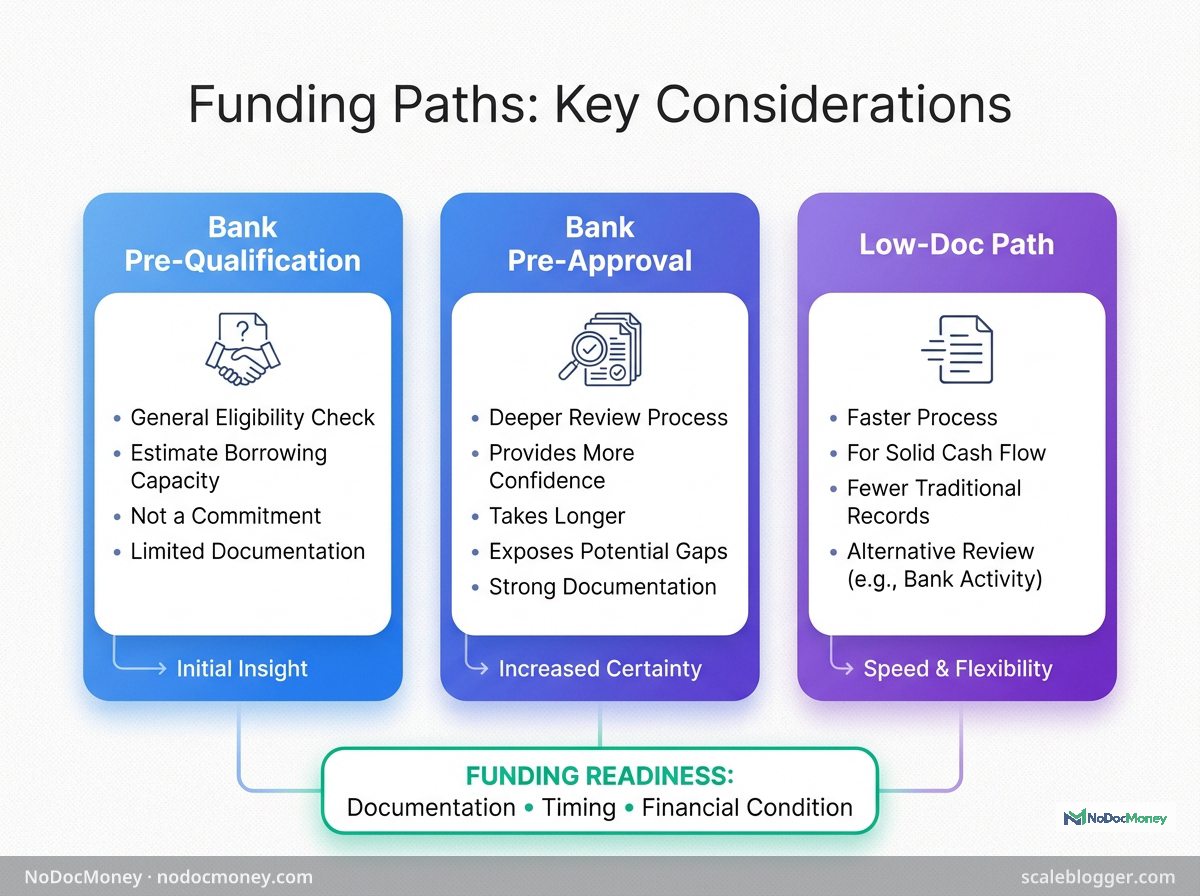
Bank pre-qualification can indicate if your business meets a lender’s general criteria.
It can help you guess how much you can borrow. But it does not promise loan approval.
Pre-approval typically requires more thorough documentation and review.
This process gives more confidence but takes more time. It may also show problems like seasonal income, owner withdrawals, fast growth, or messy records.
The choice between bank pre-qualification vs pre-approval is about more than rates or speed.
It's about how ready you are for funding: what documents you have, how fast you need money, and if your records back your business story.
A low-documentation loan may suit owners who have steady cash flow but messy paperwork.
So, the right choice depends on what works best for you.
Bank loans can build long-term ties and may cost less. Low-doc loans can help when timing or records are issues.
Your business’s situation—not just the lowest advertised rate—should guide your choice.
Table of Contents
- Bank Pre-Qualification vs. Pre-Approval: What Decision Are You Making?
- At-a-Glance Comparison: Bank Pre-Qualification vs. No-Doc Pre-Approval
- Compare the Options Criterion by Criterion
- Match the Funding Path to Your Business Situation
- Which Path Fits Your Business Right Now?
- Choose the Funding Path That Matches Your Reality
Quick Answer: Bank pre-qualification offers a quick, low-documentation way to assess potential loan eligibility but does not guarantee funding, making it suitable for businesses with solid documentation and larger funding needs. No-doc pre-approval provides faster access with minimal paperwork, fitting businesses that require urgent or smaller working capital and may have uneven financial records. Choosing between the two depends on your business’s documentation readiness, funding urgency, and loan size requirements.
Bank Pre-Qualification vs. Pre-Approval: What Decision Are You Making?
Consider whether obtaining funds quickly is the optimal choice for your business. When choosing between bank pre-qualification vs pre-approval, speed matters. But so do the documents you need, the cost, loan size, and how you will pay it back.
A usual bank review looks at your income, cash flow, credit score, debts, and business papers. Then it gives a tentative loan decision.
Pre-qualification often depends on what you say. Pre-approval checks your details more deeply.
Big banks like Bank of America, U.S. Bank, Wells Fargo, and others say pre-qualification is less sure than pre-approval. But each lender’s process differs.
| Factor | Traditional bank review | Low- or no-documentation lending |
|---|---|---|
| Approval signal | Pre-qualification may show possible fit; pre-approval is stronger but not certain. | Often faster based on fewer records, but “pre-approved” is still conditional. |
| Loan size | Better for big loans if full records show ability to repay. | Suits smaller or urgent needs, based on lender’s rules. |
| Cost | Depends on credit, collateral, financial health, and loan type. | Fewer documents don't mean lower cost; higher risk may raise fees. |
| Timing | Usually slower due to checks and underwriting. | Faster, but may have stricter terms, higher fees, or shorter payback. |
| Business fit | Good for growth, buying equipment, or building bank ties. | Useful if records are messy and money is needed fast, if repayment is realistic. |
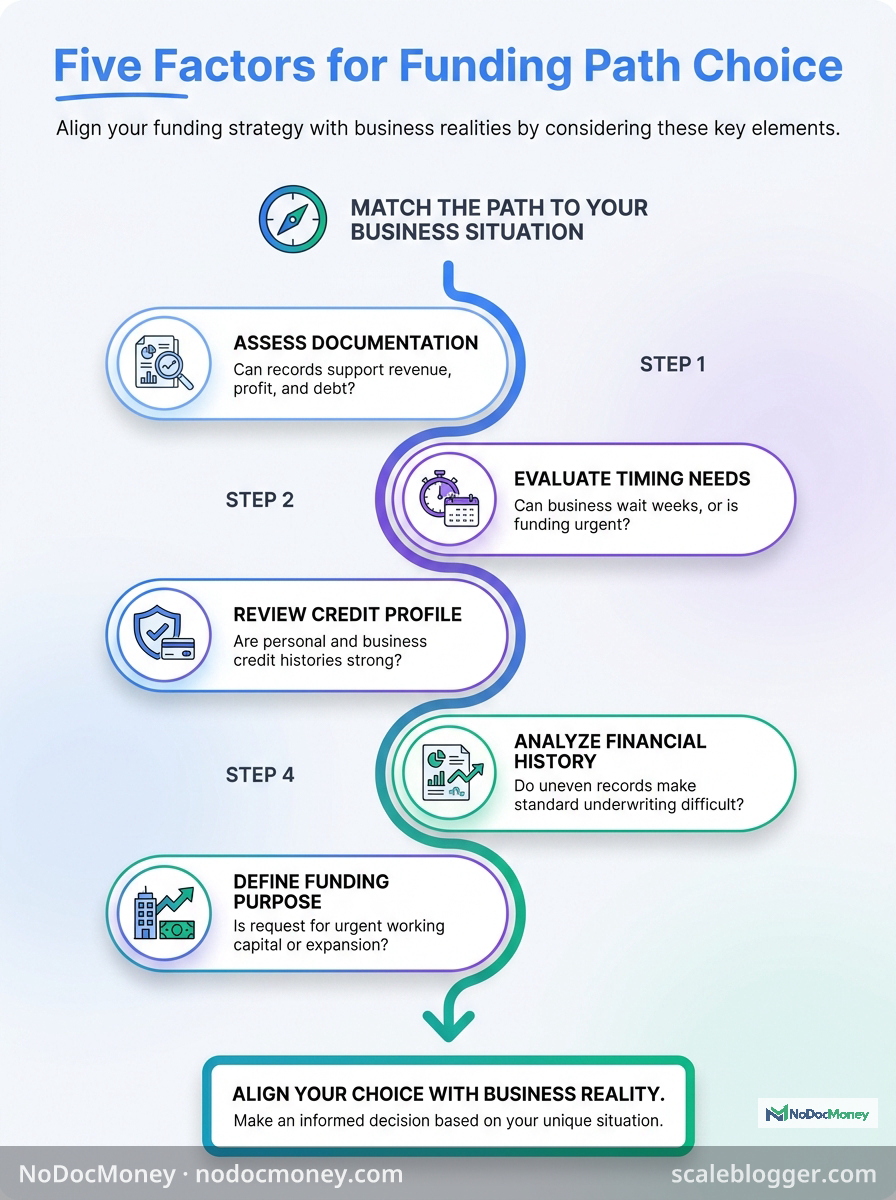
- Documents: Do your records clearly show income, profit, and debts?
- Timing: Can you wait weeks, or do bills or repairs need fast money?
- Credit: Are your personal and business credit good, average, or poor?
- Financial history: Do uneven deposits, seasonal income, or missing records hurt underwriting?
- Purpose: Do you need quick working capital, to buy equipment, or grow for the long run?
Think of a contractor who has good deposits but messy books.
A low-doc loan may help with urgent equipment needs.
A bank loan could offer better terms after cleaning records.
No option is always best.
Choose based on how fast you need the money and how solid your documents are.
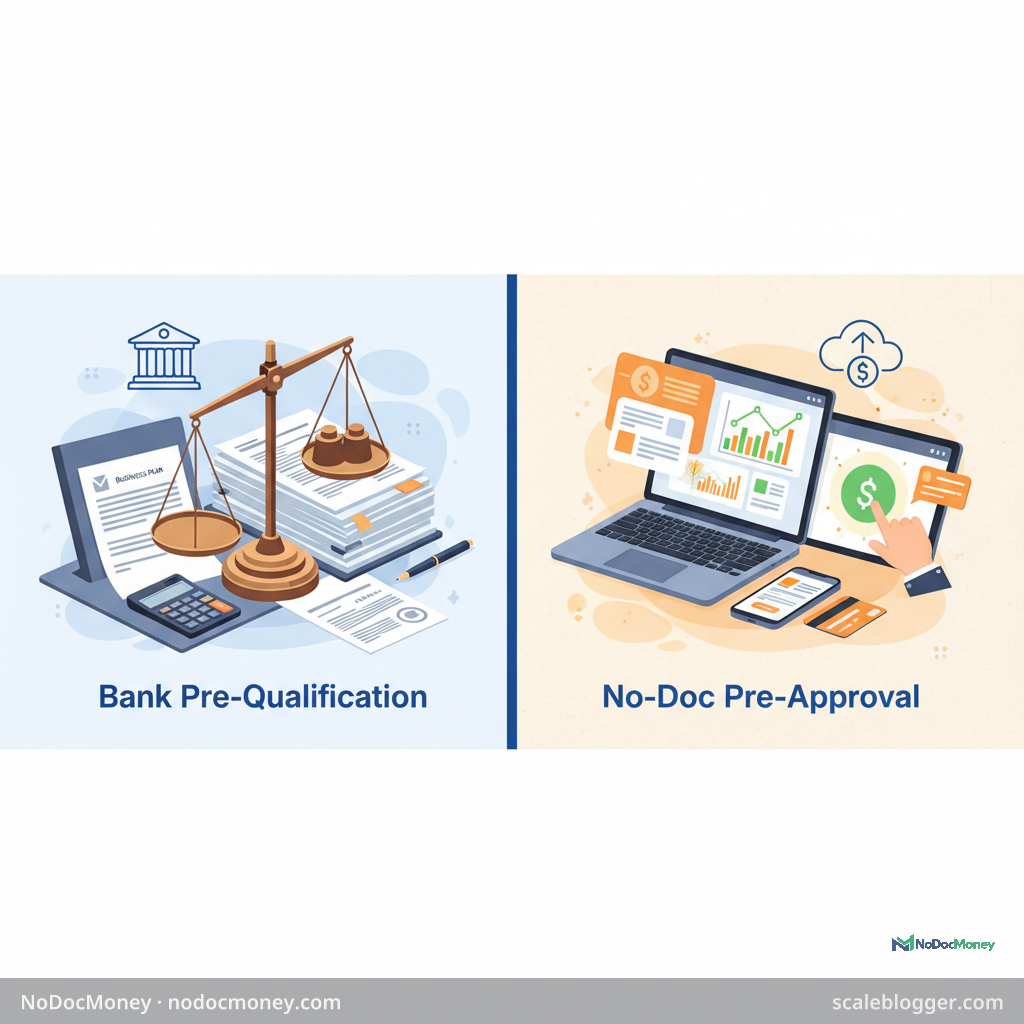
At-a-Glance Comparison: Bank Pre-Qualification vs. No-Doc Pre-Approval
Side-by-Side Business Funding Comparison
| Factor | Bank pre-qualification | Bank pre-approval | No-doc or low-doc lender |
|---|---|---|---|
| Documents | Basic info; rules vary | Tax returns, statements, debts, business papers | Bank activity, revenue, or limited records |
| Financial check | Early, often based on what you report | Deeper check of credit, cash flow, history, and payback | Focuses on recent revenue, deposits, or collateral |
| Speed | Usually faster | Usually slower due to deeper checks | Often faster, depends on processing |
| Certainty | Low; no loan promise | Higher but conditional until final ok | Varies; pre-approval may need full checks later |
| Cost | No offer yet; bank loans may cost less later | Possibly lower if financials and credit are strong | Often cost more for speed or ease of docs |
| Flexibility | Depends on later product approval | Often better for set uses and bigger loans | May fit working capital but terms vary |
| Best match | Owners preparing for future loans | Well-documented businesses wanting bigger or long loans | Businesses with messy records or urgent cash needs |
| Trade-off | Fast but uncertain | More work, stronger proof | Quicker access, higher cost, less flexible |
Compare the Options Criterion by Criterion
To see the real differences between bank pre-qualification and low-doc loans, look deeper than the surface. Think about your business records, timing, credit, and financial history. These affect lender decisions.
- Documents: Full tax returns and statements fit banks best. Other lenders may accept bank statements or partial info.
- Timing: If you need money fast, no-doc loans can be quicker but might cost more.
- Credit: Strong credit gets better bank terms. Alternative lenders may accept weaker credit but charge more.
- Financial history: Steady revenue helps bank approval. Uneven or seasonal cash flow might mean alternative loans.
- Purpose: Banks suit long-term investments. Low-doc loans may fit short-term needs.
- Cost and payback: Banks usually offer clear pricing and flexible terms. Other lenders may charge more for speed.
- Approval: Both loans give conditional approval until full checks finish. Knowing this helps set fair expectations.
Use these points to judge your business’s readiness and funding needs before picking a loan type.
Match the Funding Path to Your Business Situation
Choosing the right funding path depends on how clear your business finances are and how urgent the need is. Here’s what fits best:
| Business situation | Bank process | Low-doc review |
|---|---|---|
| Uneven income or missing records | May need more prep or cause delays | Can use recent cash flow and limited docs to speed approval |
| Urgent working money | Longer process; may not work well | Faster access priority |
| Buy equipment | Good if you can wait and have proper records | Works, with terms based on asset value and life |
| Long-term growth | Banks can offer bigger and better loans | Less fit, but possible if time is tight |
| Business buyout | Needs full checks, best with banks | Usually not enough for complex deals |
To improve your chances, organize your papers well:
- For bank loans, gather full tax returns, financial statements, and credit reports.
- For low-doc loans, focus on recent bank statements, clear funding reasons, and cash flow proof.
This prep helps you choose the loan type that fits your readiness and needs.
Which Path Fits Your Business Right Now?
Choosing between bank pre-qualification and no-doc loans depends on your documents, how fast you need money, and credit.
- Choose a bank loan if your documentation is comprehensive and you can allow for a longer process.
- Opt for a no-doc loan if expedited access or limited paperwork is a priority.
- Consider a two-step plan: get quick money first, then a bank loan later.
Before agreeing, check total costs, collateral, repayment terms, and if approvals are final or conditional. Ask each lender to be clear to avoid surprises.
Focus on:
- Banks if your papers and time match.
- Other lenders if speed or easy access matters more.
- More prep if your docs or cash flow are weak.
This way, you protect your business and lower repayment risks.
Which is better, prequalification or preapproval?
Preapproval is generally better for businesses with strong documentation seeking larger funding, as it provides more confidence through deeper verification and conditional commitments. Prequalification is quicker and requires less documentation but does not guarantee funding, making it suitable for initial assessments or businesses with less extensive records.
Is it better to be pre-qualified or pre-approved for a credit card?
Being pre-approved is better because it involves a thorough review of your credit and financial information, increasing the likelihood of approval and better terms. Prequalification is a preliminary assessment that does not guarantee credit card approval but can quickly estimate eligibility.
Which takes longer, pre-qualification or pre-approval?
Pre-approval takes longer than pre-qualification since it requires deeper verification, including tax returns, business records, and credit analysis. Pre-qualification is faster because it relies largely on borrower-reported information and involves only a preliminary review.
What do banks look at for preapproval?
For preapproval, banks review detailed financial documentation including three years of tax returns, consistent revenue streams, balance sheets, credit history, cash flow, debt details, and overall repayment capacity. This comprehensive evaluation gives banks confidence before issuing a conditional lending offer.
Can you get a business loan without documentation?
Yes, alternative lenders offer no-doc or low-documentation business loans based on recent bank activity, revenue data, or limited records. These options provide faster access to funding but may come with higher costs and are suited for businesses with uneven revenue or incomplete financial records.
Choose the Funding Path That Matches Your Reality
When choosing a funding path, pay less attention to words like 'pre-qualification' or 'pre-approval.' Instead, focus on how sure you are about funding, timing, and your documents.
Bank pre-qualification often shows you might qualify but is not a promise. Pre-approval means a deeper check that might give a firmer offer.
Low-doc loans can be fast when bank loans aren’t possible because of time or records. But these loans need careful review too.
Write down your funding needs, deadlines, and income proof. Compare offers by looking at the documents needed, if approvals depend on more checks, total costs, and terms.
Ask lenders what facts support their decisions and if approvals are conditional or final.
This helps you decide if bank loans or alternative lenders match your current readiness.